The Man with the Black Valise by John Goddard
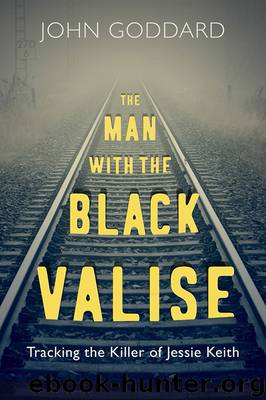
Author:John Goddard
Language: eng
Format: epub
Publisher: Dundurn
Published: 2019-09-20T16:00:00+00:00
“[Ida’s] death is particularly sad,” said the Listowel Standard, “as her decline was no doubt to a measure due to the shock and strain on her nerves through the tragic death of her sister Jessie.… The funeral on Monday was a very large one, the remains being placed by those of her murdered sister in Fairview cemetery.”
A block of stone labelled simply “Ida” was placed at the foot of the Goddess of Flora and a fresh grave dug. Again William Algie officiated at the interment, again with a flowery address.
“Kind friends,” he said, “standing on the soil made sacred by sad memories, and under the shadow of this memorial of sympathy, I thank you one and all for assembling today to do the last sad office that man can do for man. Words are barren and sounds are meaningless to express our sorrow for the bereaved parents, who today consign to the ‘windowless place of rest’ the dear remains of a loved and loving daughter.”
In 1917, Jane Keith, William’s wife and the mother of the three children, died at sixty-nine, also of “consumption,” also attributed to the effects of the murder. “Mrs. Keith had been ailing since the time of the [Jessie Keith] tragedy,” the Listowel Banner said.
In 1920, Alexander “Sandy” Keith, the youngest of the three children, died unmarried at thirty-four. No other information about him survives, except that he had continued to live with his father in the family home, always within sight of the rise along the railway tracks in the neighbouring field. After Sandy’s death, William sold the farm and moved nearby to live with his nephew James.
William Keith lived to be almost ninety. He outlived everybody else in the family and died in 1928 of peritonitis, an abdominal infection, having enjoyed good health until then. Obituaries recalled the central tragedy of his life obliquely, perhaps because everybody already knew the details.
“Thirty-four years ago his second daughter, Jessie, was the victim of a terrible tragedy, which was a great trial,” the Banner said, without elaborating.
After writing in his logbook, “This day Jessie was murdered,” William Keith made no further entries for the rest of 1894 or part of the next year. He gave himself time to mourn, and, when he was ready, began to reengage with the world. Throughout his life, he showed a rare ability to stay true to his own values and beliefs, to live on his own terms, and at the same time associate with a broad cross-section of society. He continued to serve as secretary of the North Perth Farmers’ Institute. He went on to sit as a municipal councillor and as a justice of the peace, community service roles that must have helped him reconnect.
“A man of considerable intelligence and read much,” the Monkton Times said after his death.
His funeral was well attended. Friends and acquaintances travelled from as far away as Kitchener, Wingham, Brantford, and Clifford. To the end, he remained a freethinker, or secularist. He generally gave Christian clergymen
Download
This site does not store any files on its server. We only index and link to content provided by other sites. Please contact the content providers to delete copyright contents if any and email us, we'll remove relevant links or contents immediately.
Mindhunter: Inside the FBI's Elite Serial Crime Unit by John E. Douglas & Mark Olshaker(9339)
Wiseguy by Nicholas Pileggi(5782)
Room 212 by Kate Stewart(5119)
Hitman by Howie Carr(5094)
Secrecy World by Jake Bernstein(4752)
Killers of the Flower Moon: The Osage Murders and the Birth of the FBI by David Grann(4447)
Papillon (English) by Henri Charrière(4274)
Breaking Free by Rachel Jeffs(4217)
Killers of the Flower Moon by David Grann(4055)
Say Nothing by Patrick Radden Keefe(3984)
American Kingpin by Nick Bilton(3886)
The Secret Barrister by The Secret Barrister(3708)
Molly's Game: From Hollywood's Elite to Wall Street's Billionaire Boys Club, My High-Stakes Adventure in the World of Underground Poker by Molly Bloom(3536)
Mysteries by Colin Wilson(3454)
In Cold Blood by Truman Capote(3384)
Signature in the Cell: DNA and the Evidence for Intelligent Design by Stephen C. Meyer(3138)
I'll Be Gone in the Dark by Michelle McNamara(3082)
Rogue Trader by Leeson Nick(3043)
Bunk by Kevin Young(2997)
